

Huge retrofit potential for green and multifunctional roofscapes
Benefits of a green roof
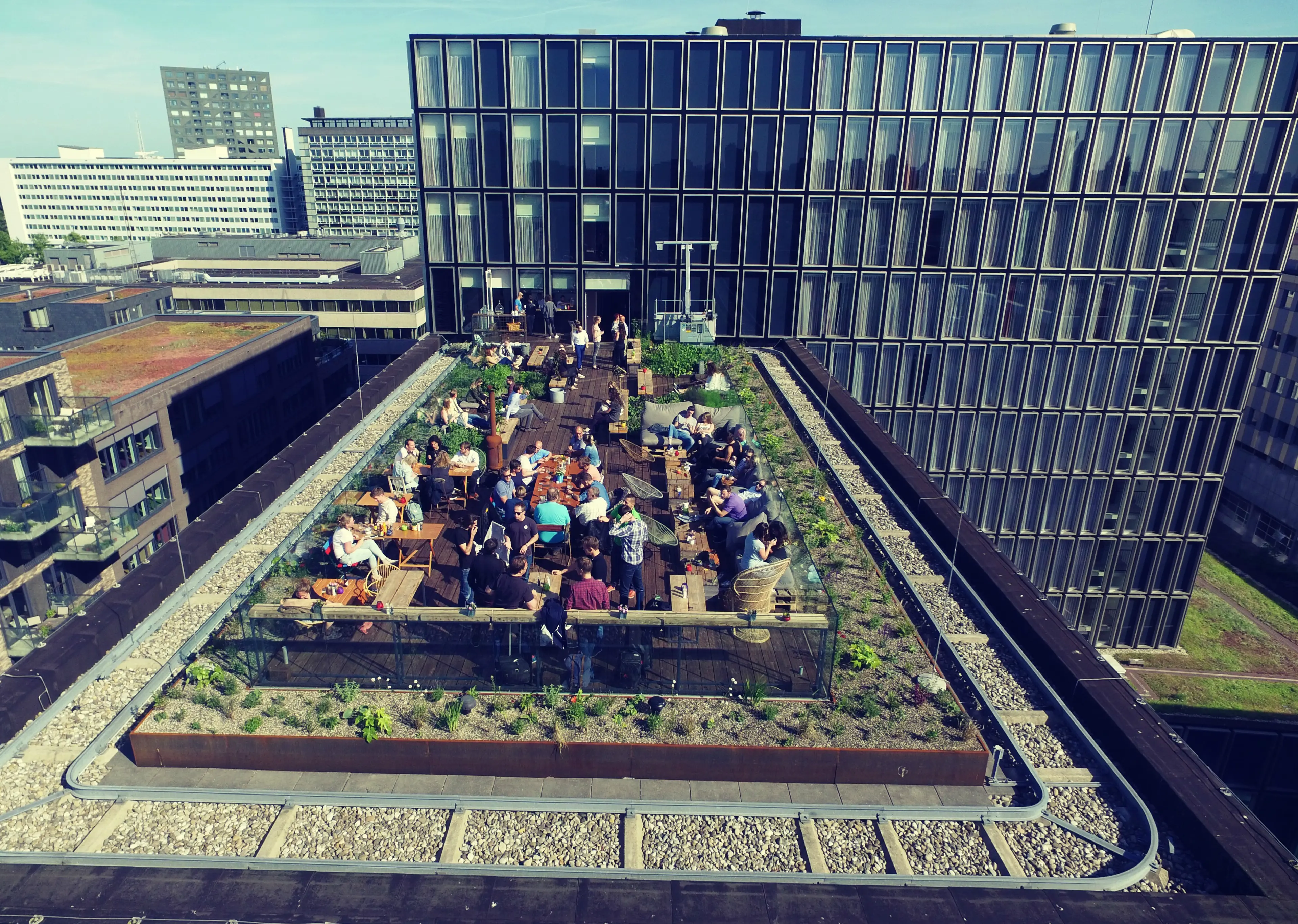
Rooftopbar Nest
This article was translated with AI support.
This article was translated with AI support.

Do you have questions about our products and services? Use our contact form to get in touch.

Unit 1, Park Lane Business Park, Park Lane, Kirkby-in-Ashfield, Nottingham NG17 9GU
T +44 1623 627 285
E info.uk@ccm-europe.com
ARBO® Customer Service:

Black bitumen roofs are the tarred smoker's lungs of our city," says Friso Klapwijk of the Amsterdam planning firm "De Dakdokters" with deliberate provocation. "We want every one of these roofs to be able to breathe freely so our city can be healthy again. That is our mission. And that is why we have set ourselves the goal of greening as many roofs as we possibly can.

Friso Klapwijk
Amsterdam planning firm "De Dakdokters"
Admittedly, positioning a planning firm and roofing contractor as "roof doctors" shows first and foremost a sharp instinct for marketing. But Friso Klapwijk is entirely serious about the cause behind the name. Ask the managing director of the firm, founded in 2010, and he will tell you that most flat roofs in our cities are truly unwell: "Ecologically speaking, all of these surfaces are completely worthless," he says of the status quo. "They contribute to the further overheating of our cities and, at best, are used to mount technical equipment. Meanwhile, precious rainwater is piped straight into the sewers, so our cities become ever more sealed. To put an end to this madness, we should finally start greening every one of these flat-roof surfaces and make our environment healthier in the process."
The topic has gained additional urgency from the COVID-19 pandemic: "People are spending much more time at home at the moment, and as a result they are far more attuned to the quality of their immediate environment," says Friso Klapwijk. "That has strengthened the desire to look out at greenery and step outside for fresh air during the day. Many companies are already responding to this need and converting existing roof surfaces into roof gardens, so that employees can go outside during breaks or even work outdoors."
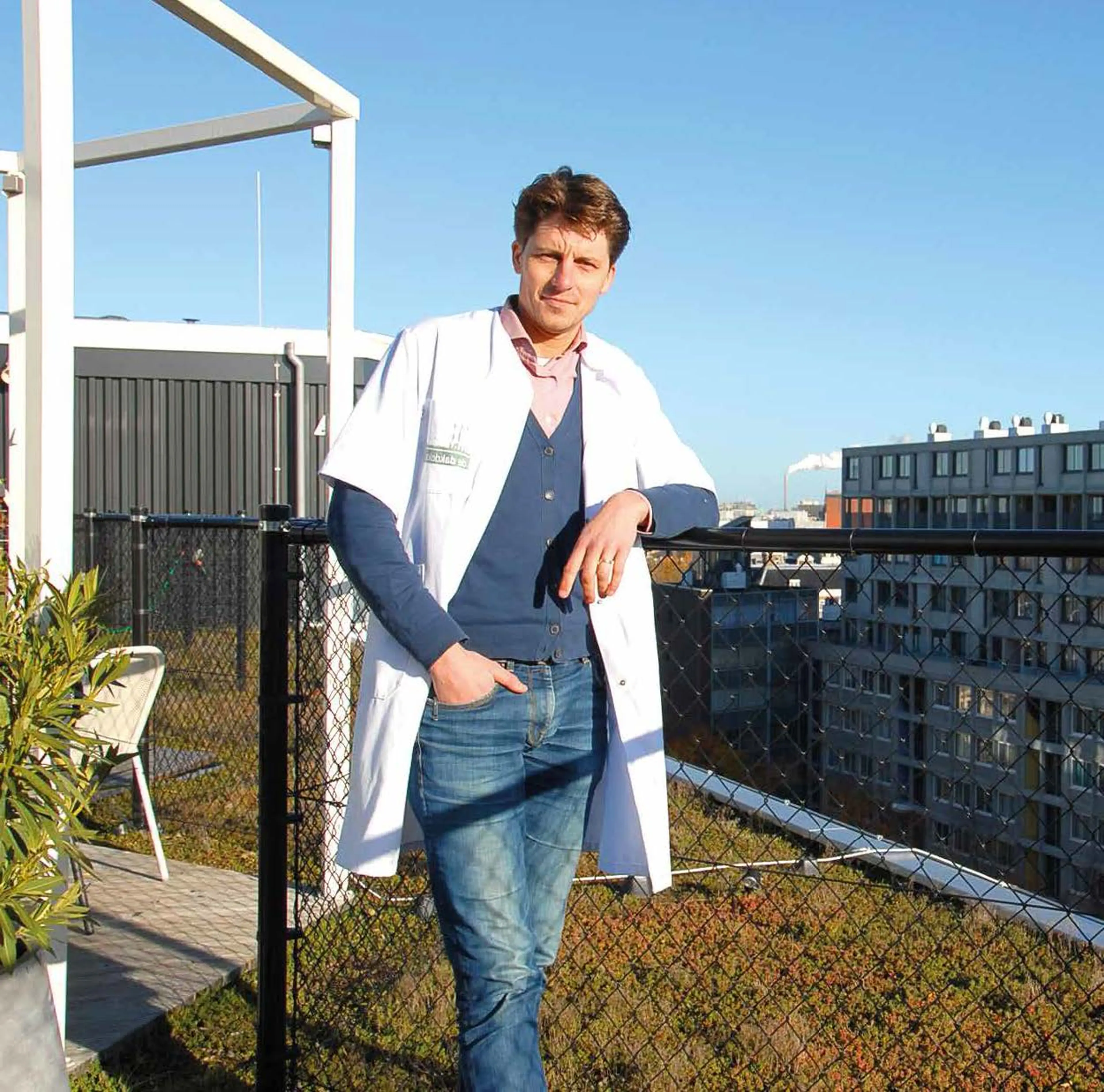
De Dakdokters sees itself as both a landscape planning firm and a roofing contractor: "So we don't just design roof gardens, we build them too," explains Friso Klapwijk, who is also a board member of the Nationaal Dakenplan association and a member of VHG, the Dutch trade association for green roofs.
"As a rule, we work on existing buildings. That is why we have deliberately built an interdisciplinary team of architects, carpenters, roofers, building physicists and gardeners, so we can offer broad know-how on all kinds of roof constructions and every detail of building physics from a single source. It is also very important to us that we only take on roof refurbishments that end with a roof garden or a green roof. And the potential is enormous: around 80 per cent of all flat roofs in Amsterdam are suitable for greening or for use as a multifunctional roofscape."
Friso Klapwijk's passion for green roofs has accompanied him all his life. It was with this in mind that he began his civil engineering degree: "Unfortunately, I quickly discovered that it was all about asphalt and concrete," he recalls, with a tone of sober hindsight. He eventually joined Arcadis instead, an international provider of consultancy, project management and engineering services in infrastructure, water, environment and real estate, to take part in a sustainability study for the City of Rotterdam: "We were rather surprised to find that existing efforts in this area were almost exclusively aimed at new-builds, and that there was a correspondingly huge potential in refurbishing existing buildings."
Shortly afterwards, the idea for "De Dakdokters" was born: "My two former partners came up with the name one night in a pub," Friso Klapwijk recalls with a laugh. "They then turned up to a major presentation wearing white doctors' coats. I only heard about the idea through a newspaper article about that event — and got in touch with them. That is how it all started. And now, ten years on, 27 full-time employees and ten freelancers are working successfully to deliver our mission."
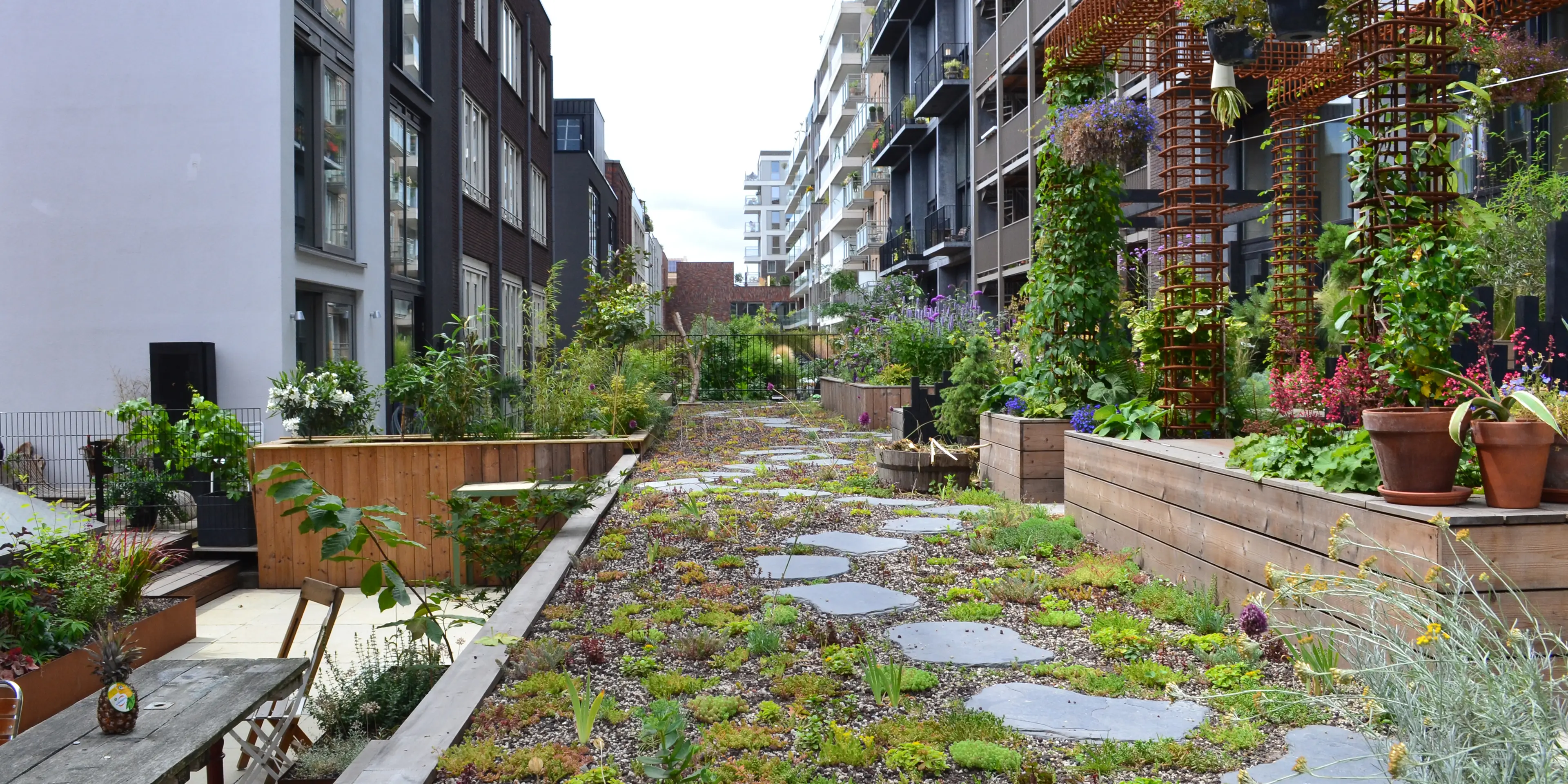
The green roof benefits are wide-ranging. "On the one hand, they improve air quality and significantly increase biodiversity in our cities because they attract insects and birds; on the other, a green roof is simply much nicer to look at," says Friso Klapwijk. "That is why I find it absolutely incomprehensible that children in schools, patients in hospitals and older people in care homes should routinely have to look out onto black roofs. It has long been established that the sight of green spaces has a positive effect on our health." On top of that, green roofs act as a summer heat buffer and a winter thermal store for the building, and they also have a positive thermal effect on the city as a whole, helping to mitigate the urban heat island effect. Because green roofs have a noticeably lower surface temperature than materials such as bitumen or gravel, they warm the surrounding air far less. From a building-physics perspective, the lower heat, combined with reduced light and UV exposure, also means the roof build-up ages more slowly, extending the service life of the roof waterproofing considerably.
Friso Klapwijk cites further green roof benefits: optimised rainwater retention and the resulting relief on the sewer system during heavy rainfall. "It is very important to us that we see rainwater as a valuable resource, not as 'waste' to be flushed into the drainage system as quickly as possible," he explains. "That is why we increasingly deploy our Polder roof system, which consists of several modular boxes in which rainwater can be stored.
On one hand, the system can be used for irrigation; on the other, it allows for a delayed, flood-safe discharge of rainwater into the sewer." The benefits above come into their own above all with intensive green roofs: "Many green roofs are only covered with Sedum," Friso Klapwijk explains. "That is a first step, at least. But from an ecological point of view it is of course much better to choose intensive planting and create a roof garden with shrubs or trees."
Just how deeply sustainability matters to the roof doctors is demonstrated not least through a dedicated sponsorship programme: to pursue their most important goal, the firm invests ten per cent of its profits into roof gardens for schools and other places that could not otherwise be realised. One of the Dakdokters' earliest projects was the roof refurbishment of the "American Book Center" in the centre of Amsterdam: "We had a great deal of support at the time, both from our client and from our suppliers," Friso Klapwijk recalls. "CARLISLE® was one of them — they supplied us with their HERTALAN® EASY COVER EPDM-Membranes and are also a partner of the Nationaal Dakenplan association. Since then, we have steadily evolved our own business, and we have watched CARLISLE® continuously expand its product range too. When it comes to EPDM, we now work predominantly with RESITRIX® membranes, which are perfectly suited to Amsterdam roofs with all their many details."
Looking ahead, Friso Klapwijk hopes to see green roofs become even more widespread: "I want to encourage prospective building owners to consider integrating green roofs as early as the design phase, because that is the only way to ensure an optimal roof build-up and an optimal usage concept later on. I would also urge the entire industry to develop smart solutions — for example around circularity, or on insurance models for fully green roofs. But looking beyond our own sector, I believe these are questions we need to answer as a society too."